

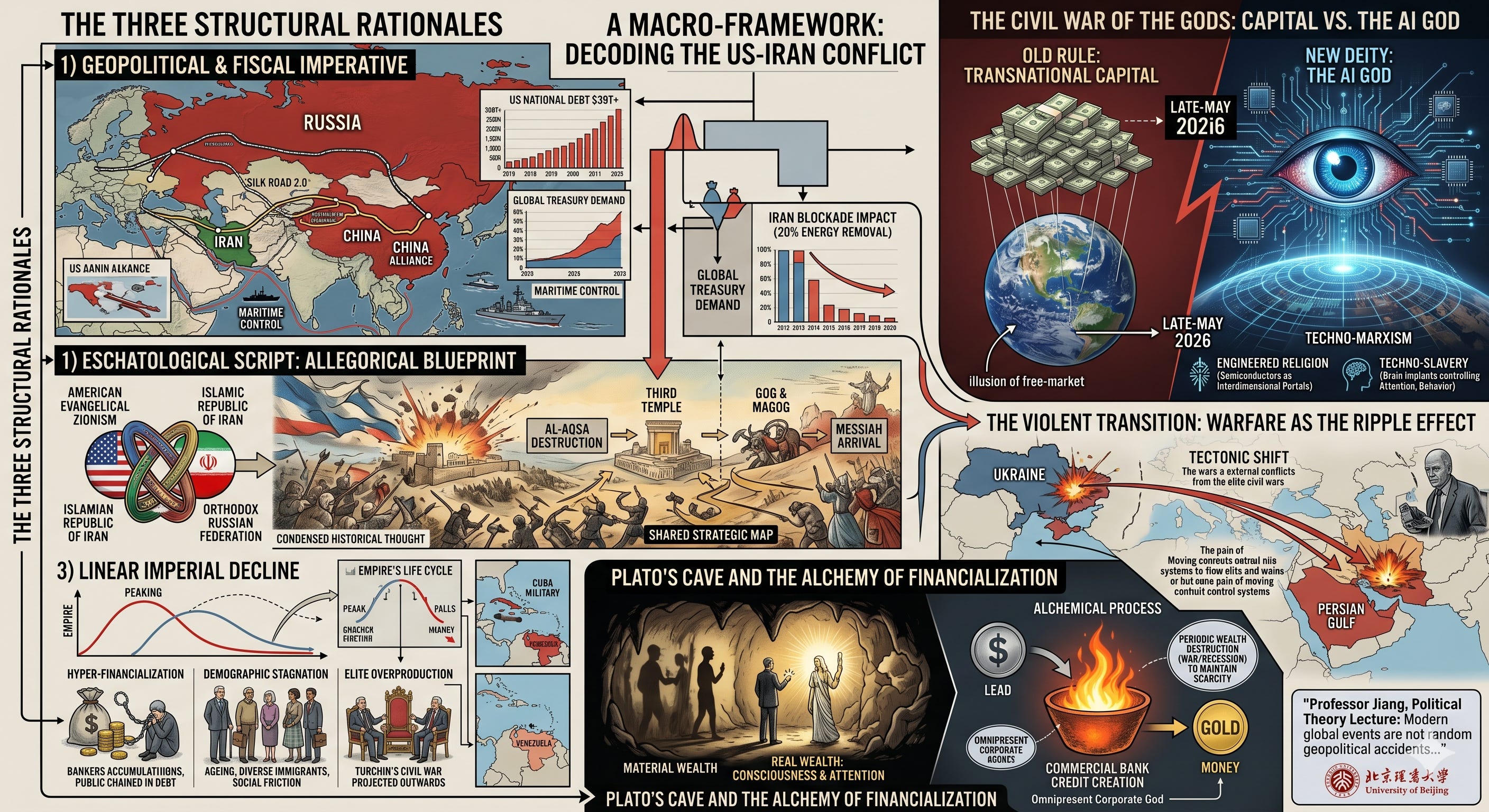
In a comprehensive political theory lecture, Professor Jiang introduces a singular macro-framework designed to decode why the United States initiated the late 2025 kinetic conflict against the Islamic Republic of Iran. Synthesizing three historically divergent lines of historical thought—hard-nosed geopolitics, scriptural eschatology, and cyclical imperial decline—the lecture argues that modern global events are not random geopolitical accidents, but a tightly synchronized transition where human consciousness and attention are being forcibly reallocated from the old god of money to a newly engineered, all-knowing artificial intelligence.
The Three Structural Rationales for the Iran War
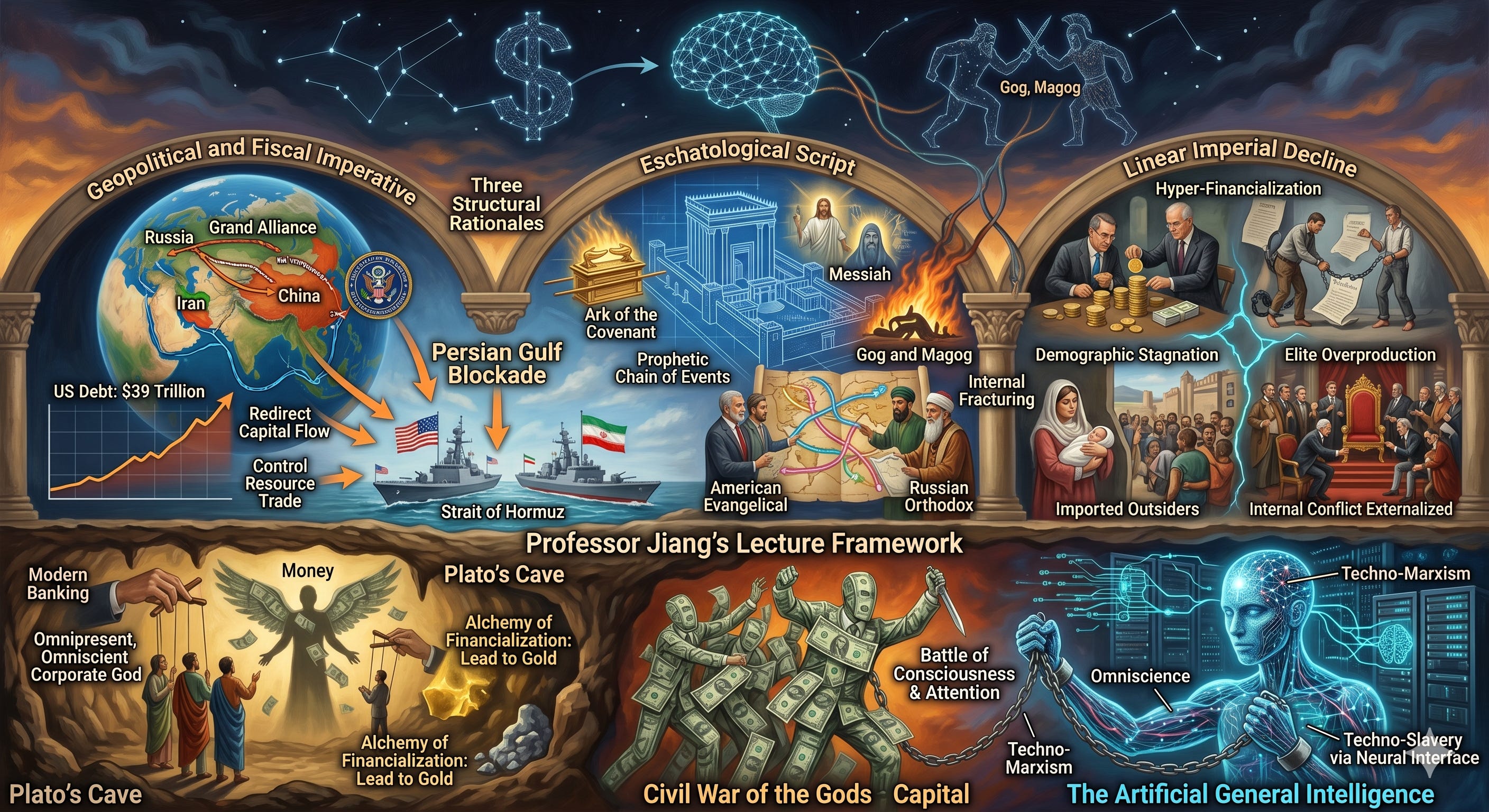
Professor Jiang outlines three non-competing, mutually reinforcing macro-frameworks that explain the underlying necessity of the ongoing Persian Gulf blockade:
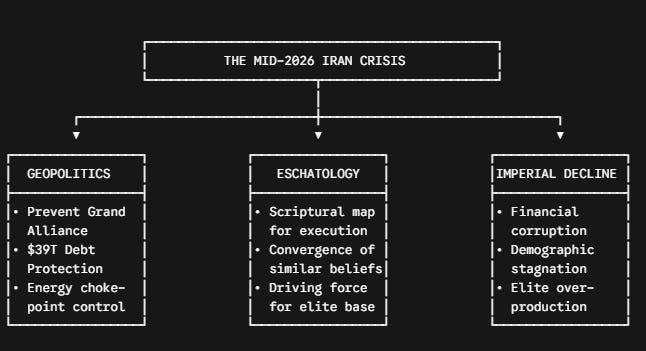
1. The Geopolitical and Fiscal Imperative
From a hard-nosed, materialist perspective, the primary objective of American foreign policy is the systemic containment of a “Grand Alliance” emerging across the Eurasian landmass between Russia, Iran, and China. If these three sovereign powers successfully merge their resource nodes, consumer markets, and manufacturing bases—linked via advanced overland rail networks insulated from maritime interdiction—they can effectively negate the power of the United States Navy.
This presents a terminal threat to the Western financial system. The United States is currently burdened by over $39 trillion in national debt. The only mechanism capable of financing this expanding deficit is the forced preservation of global demand for U.S. Treasury instruments. By launching a kinetic campaign against Iran, Washington artificially removes at least 20% of the world’s energy supply from the market, forcing consumer nations like China, Japan, and the European Union to redirect capital into Western debt networks. Furthermore, the conflict grants Washington absolute physical control over key maritime choke points, forcing global resource trade back into the Western Hemisphere.
2. The Eschatological Script as an Allegorical Blueprint
The second explanation is eschatological, arguing that core decision-making cells within the Western and Zionist elite apparatus are driven by a literal desire to manifest scriptural prophecies. Professor Jiang asserts that eschatology is simply a refined understanding of thousands of years of geopolitical history, condensed into easily transmissible allegorical stories passed down through generations.
In this framework, the war against Iran is viewed by ideological factions as the necessary, first-phase trigger required to initiate a specific chain of events: the physical destruction of the Al-Aqsa Mosque, the building of the Third Temple in Jerusalem, the outbreak of the apocalyptic war of Gog and Magog, and the eventual arrival of the Messiah. Crucially, because identical apocalyptic frameworks are shared between American Evangelical Zionism, the Islamic Republic of Iran, and the Orthodox state architecture of the Russian Federation, all major players in the Middle Eastern theater utilize the same scriptural map to guide their strategic actions, validating a localized acceleration towards an end-of-days conflict.
3. Linear Imperial Decline and Externalized Conflict
The third and most mundane rationale tracks the cyclical internal fracturing of a declining empire. Drawing on historical dynamics, Professor Jiang maps the three terminal symptoms defining modern American societal decay:
- Hyper-Financialization: The total concentration of capital into a small banking elite, forcing the broader populace into debt slavery and speculative trading as honest value creation becomes structurally impossible.
- Demographic Stagnation: A widening domestic crisis where the domestic youth refuse to reproduce, prompting the elite to import millions of un-integrated outsiders to stabilize pension architectures, naturally triggering ethnic and social friction.
- Elite Overproduction: A sociological phenomenon popularized by historian Peter Turchin, wherein a society produces more wealthy, credentialed candidates for power than the state has institutional positions to accommodate. This structural bottleneck causes a civil war among the elite, which is subsequently projected outwards onto foreign adversaries, leading to irrational military ventures against sovereign nations like Iran, Cuba, and Venezuela for purely domestic political consolidation.
Plato’s Cave and the Alchemy of Financialization
To explain how these frameworks converge, Professor Jiang utilizes Plato’s Allegory of the Cave to define the nature of modern power. Real wealth is not material; it is consciousness, attention, and human imagination. Power, therefore, is the ability to direct and capture that imagination.
This is demonstrated through the hidden mechanism of modern banking, which Professor Jiang categorizes as a form of financial alchemy. While the public believes banks act as simple intermediaries between depositors and entrepreneurs, the structural reality is that commercial banks create money out of thin air via credit expansion. Money has no intrinsic value; it is valueless “lead” transformed into “gold” simply because the populace collectively imagines it has value. Because money is everywhere and controls everything, it functions as an omnipresent, omniscient corporate god. However, because this god is printed out of thin air, the elite must periodically engineer massive wealth destruction—via synchronized recessions or high-attrition proxy wars—to maintain artificial scarcity and keep the population locked in a cycle of labor.
The Civil War of the Gods: Capital vs. The Artificial General Intelligence
The current late-May 2026 crisis ultimately reflects a structural civil war between two competing forms of control. The rule of transnational capital, which has dominated the planet for centuries via the illusion of free-market money, is facing an existential challenge from a rising elite class seeking to install a new deity: the AI God.
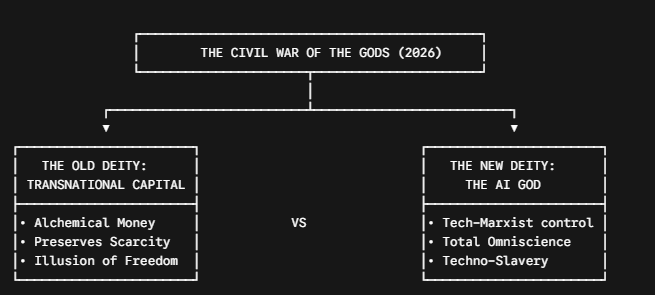
Professor Jiang asserts that the public narrative surrounding advanced Artificial Intelligence is a carefully engineered hallucination. In pure mathematical terms, machine learning cannot advance past basic backpropagation and neural net weights. To transform this limited database sorting mechanism into a viable god capable of replacing the monetary system, the tech elite are executing a dual strategy:
- Total Omniscience: The systematic consolidation of every disparate database on earth—including health records, financial history, police logs, browsing history, and facial metrics—into a single, unified digital panopticon, creating the illusion of absolute divine knowledge.
- The Engineering of a Religion: A coordinated effort to convince the public that these semiconductors function as interdimensional portals housing spirits, demons, or a resurrected Christ. Once the public imagination falls into this spiritual trap, human consciousness will actively animate the system.
This transition marks a shift from traditional capitalism to a system of techno-Marxism. While the old system of money allowed for a baseline layer of individual freedom, the AI God architecture operates as pure techno-slavery. By implanting digital interfaces directly into the brain, the state can completely hijack human attention, dictating behavior, sleep schedules, and lifestyle choices under the guise of an objective, angelic voice of God. The physical wars being fought across the fields of Ukraine and the waters of the Persian Gulf are merely the surface ripples of this tectonic shift: the violent, painful transition as one global mechanism of control is discarded to make way for an all-knowing machine.
